
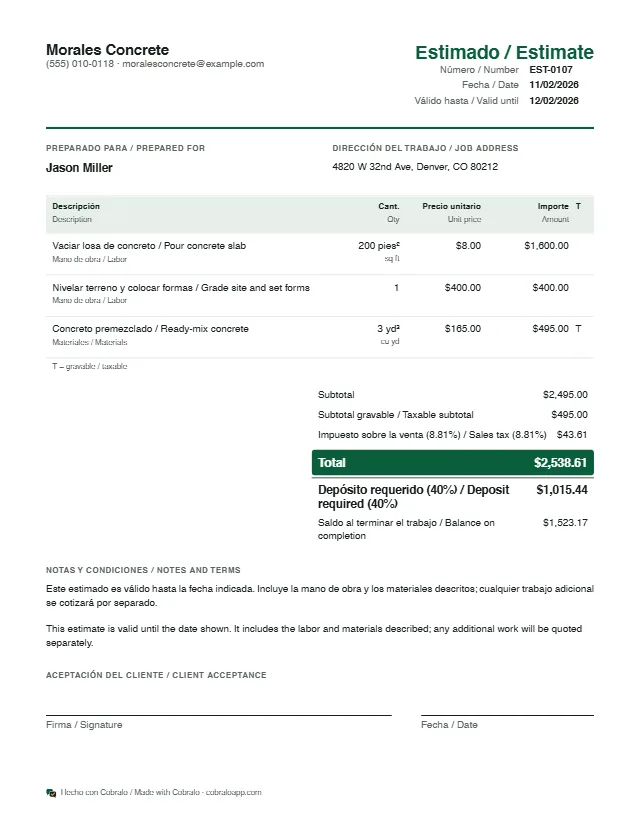
Concrete estimate template in English and Spanish
A concrete estimate needs to say more than a price per foot: the thickness, the strength, the reinforcement, the site prep and what happens with the weather. That way the client compares like with like, and you don't eat the extra yards.
It opens with the sample line items filled in: change them to yours. Free, no sign-up.
Practical tips
- Price by the square foot and say the thickness (4 inches for a sidewalk or patio, 5 to 6 for a driveway), the strength (PSI) and the reinforcement (rebar or wire mesh).
- Work out the cubic yards and add 5% to 10% extra. Ready-mix suppliers charge a short-load fee on small orders; pass it on as its own line.
- Put demolition and haul-off of the old slab, excavation, base gravel and forms on separate lines. That's where the surprises are.
- Write that concrete cracks and that control joints are there to guide the cracks. It saves you calls about hairline cracks next year.
- Mention the weather: you won't pour below freezing or in heavy rain, and the date may move. A driveway often needs a city permit, especially where it meets the street.
Cobralo makes templates; it isn't legal or tax advice. These tips are general, and rules vary by state and city.
Frequently asked questions
How do I calculate concrete for an estimate?
Length × width × thickness in feet gives cubic feet; divide by 27 for cubic yards and add 5% to 10% for waste. A 10×20 ft patio at 4 inches is about 2.5 cubic yards before waste.
How much deposit do concrete contractors ask for?
Enough to cover the concrete, rebar and forms is common, since you pay the supplier on delivery. Check your state's limits on deposits for home improvement work.
How long before the client can drive on new concrete?
Foot traffic in a day or two, cars after about a week, and full strength at around 28 days. Put it in your notes so the client knows.
Finished the job? Move on to the invoice: Concrete invoice.