
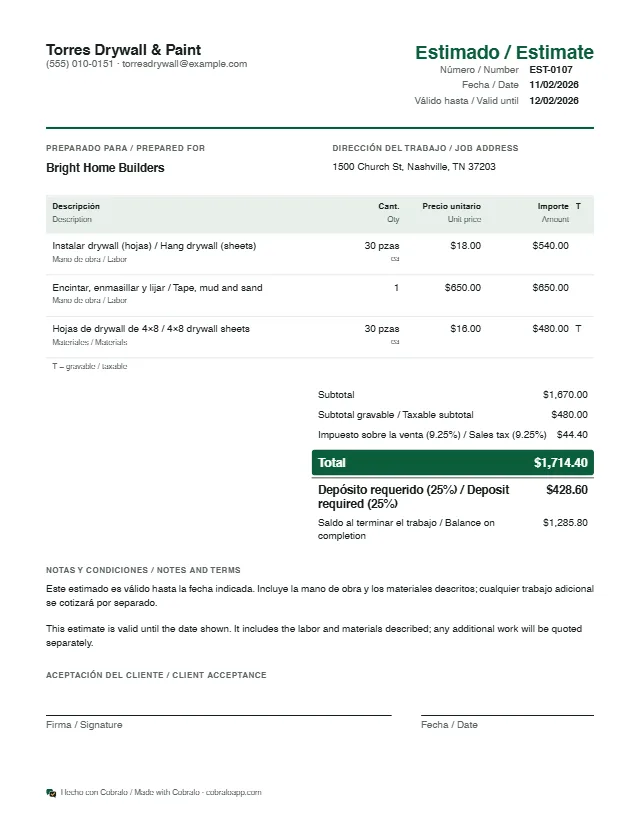
Drywall estimate template in English and Spanish
In drywall, almost every argument is about the finish: "the walls aren't smooth." An estimate that says how many sheets, what type and what finish level settles it before you open the first bucket of mud.
It opens with the sample line items filled in: change them to yours. Free, no sign-up.
Practical tips
- Price new drywall by the sheet or the square foot, and say the sheet size and thickness (1/2" on walls, 5/8" fire-rated where code requires it, moisture-resistant in bathrooms).
- Name the finish level. Level 4 is standard for painted walls; Level 5 (a skim coat over everything) costs more and is for glossy paint or strong light. Naming the level prevents complaints.
- On repairs, talk about the texture: matching an existing orange peel or knockdown comes close, rarely perfect. Write that it will "blend," not "match exactly."
- Say whether painting is included. Many drywall jobs end at primer; if the client expects a painted wall, that's another line or another trade.
- If you're repairing water damage, write that the leak must be fixed first, and that any mold you find is priced separately.
Cobralo makes templates; it isn't legal or tax advice. These tips are general, and rules vary by state and city.
Frequently asked questions
How do I estimate a drywall job?
Measure the wall and ceiling area, divide by the sheet size (32 square feet for a 4×8) and add about 10% for waste. Price hanging, taping and finishing per sheet or per square foot, plus materials, corner bead and cleanup.
What are drywall finish levels?
An industry scale from 0 (just hung) to 5 (fully skim-coated). Level 4 is standard for walls with flat or eggshell paint. Put the level on your estimate so you and the client mean the same thing.
Should I charge separately for small patches?
Yes. Many contractors set a minimum for patch work, because even a small patch needs several visits so the mud can dry between coats.
Finished the job? Move on to the invoice: Drywall invoice.