
Handyman estimate template in English and Spanish
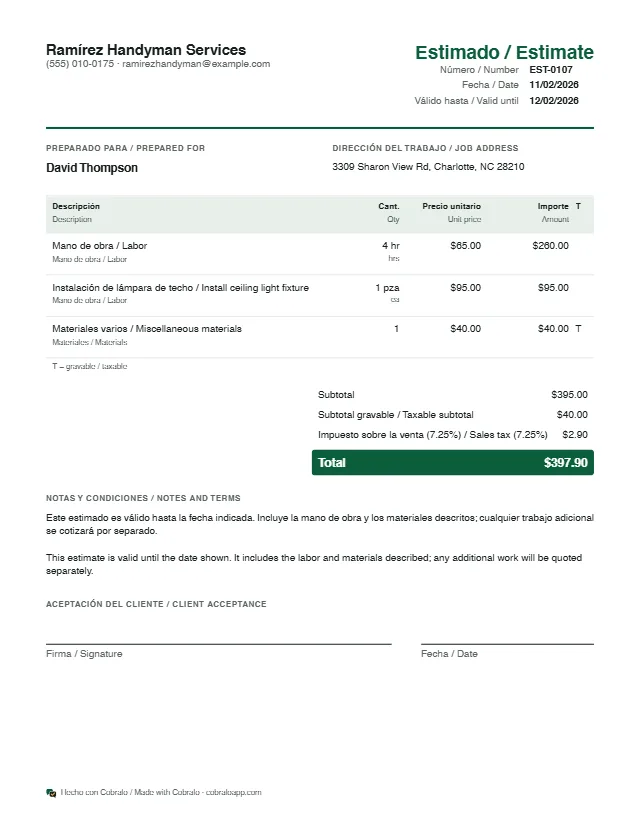
Handyman work is almost always a list: a door that won't close, a dripping faucet, three outlets to replace. An estimate with one task per line lets the client approve everything or pick, and lets you charge what each task is worth.
It opens with the sample line items filled in: change them to yours. Free, no sign-up.
Practical tips
- Put each task on its own line (hang a door, fix a dripping faucet, replace three outlets). Clients approve small jobs one by one, and if the total is too high, it's easy to drop one.
- Say whether you charge by the hour or by the task, and whether there's a minimum or a service call fee. A service call minimum pays for the drive to a 15-minute job.
- Know your state's limit. Many states require a contractor's license above a certain dollar amount per job, and electrical, plumbing and gas work usually needs a licensed tradesperson whatever the size.
- Write who buys the materials. If you buy them, put them on a materials line with your markup; if the client buys them, say so.
- Note that hidden damage (rot behind the tile, bad wiring behind the wall) is priced separately before you fix it.
Cobralo makes templates; it isn't legal or tax advice. These tips are general, and rules vary by state and city.
Frequently asked questions
How much should a handyman charge?
It depends on the city, but most handymen charge an hourly rate with a one- or two-hour minimum, or a flat price per task. Add materials, the service call fee and disposal.
Do I need a license to work as a handyman?
It depends on your state and the size of the job. Many states let you work without a contractor's license under a dollar limit per job; above it, or for electrical, plumbing and HVAC, you need one. Check with your state's licensing board.
Can I put several small jobs on one estimate?
Yes, that's the best way: one line per task with its own price. The client can approve them all or pick some.
Finished the job? Move on to the invoice: Handyman invoice.